
How to Bundle Digital Products to Increase Your Sales
 BishopAL
Super Moderator
Author
BishopAL
Super Moderator
Author
Sometimes the easiest way to create a better offer isn't creating another product. It's combining the products you already have.
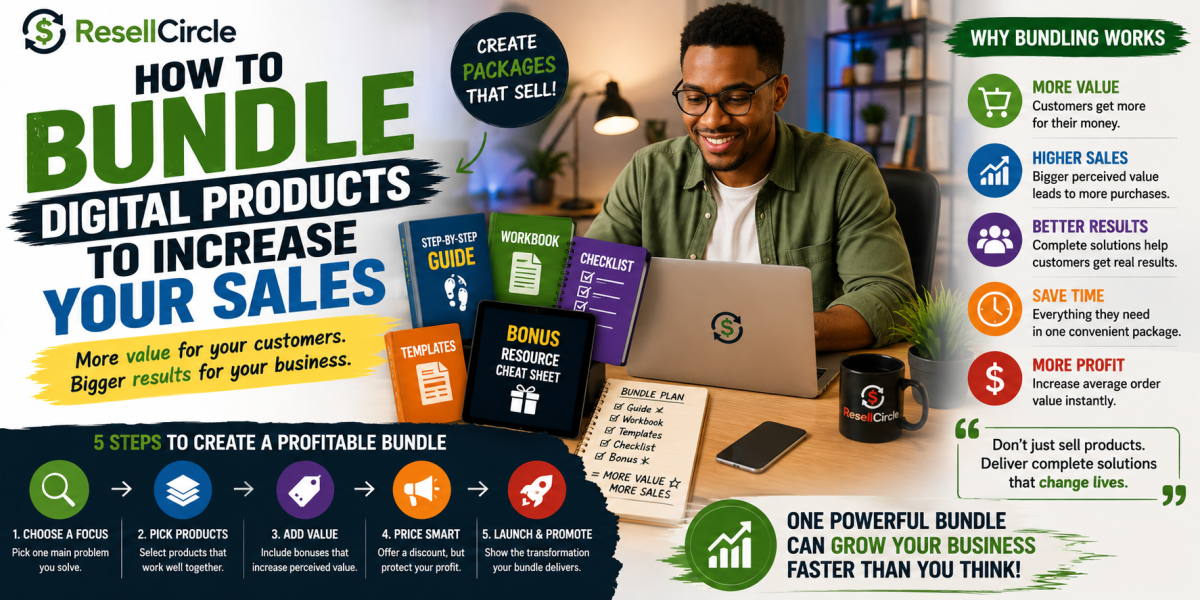
One thing I want Resell Circle creators to understand is that growing your digital product income doesn't always mean you have to keep creating something new. If you already have two, three, or four products that work well together, you may already have everything you need to create a stronger offer. That's where bundling comes in. A bundle takes several related digital products and packages them together as one solution. The customer gets more value, you have an opportunity to increase the amount of each sale, and products that may have been overlooked individually can become more attractive when they're part of a complete package.
Start With One Main Problem
Don't bundle products simply because you have them. A strong bundle should make sense and should be built around something your customer is trying to accomplish. Start by asking yourself, "What problem is my customer trying to solve, and which of my products can help them solve it?"
Suppose you create products for people who want to start a small business. You might already have a startup guide, business checklist, budgeting spreadsheet, marketing templates, and workbook. Individually, each product solves one part of the problem. Together, they could become a Small Business Startup Bundle that helps someone move from having an idea to actually getting their business started. Now you're not selling five random downloads. You're selling a more complete solution.
Give Customers a Reason to Buy the Bundle
The customer should immediately understand why purchasing the bundle makes sense. One obvious advantage is price. If your eBook sells for $19, your workbook for $15, your templates for $17, and your checklist for $9, purchasing everything separately would cost $60. You might decide to offer the complete bundle for $39 or $47.
The customer receives a discount for purchasing everything together, while you have the opportunity to turn what might have been a $9 or $19 sale into a $39 or $47 sale. But price shouldn't be the only advantage. The bigger selling point is that you're giving the customer everything they need in one place instead of making them search for each piece individually.
Build Your Bundle Around the Customer's Journey
I like to think about a good bundle as a journey. Ask yourself what the customer needs first, what they'll need after that, and what could help them complete the process. When the products follow a logical order, the bundle becomes much more useful.
For example, if you're teaching social media marketing, you could combine a beginner's guide, content calendar, caption templates, graphics checklist, and posting planner. The guide teaches the strategy, the calendar helps them plan, the templates help them create, and the checklist keeps them on track. Each product has its own purpose, but together they help the customer reach a larger goal.
Use Products You've Already Created
This is one of the things I like most about bundling. You don't necessarily have to create anything new. Look through the digital products you've already made and see which ones naturally belong together. You may discover that three or four products you've been selling separately could become a premium package today.
You can still sell those products individually. The bundle simply gives your customers another option. One customer may only need your $15 guide, while another customer may see your $49 bundle and decide they'd rather spend a little more and get everything. You're allowing the customer to choose the level of value that's right for them.
Make the Value Easy to See
Don't make customers do the math themselves. Show them exactly what they're receiving and what each item would normally cost. When people can clearly see the total value compared with the bundle price, it becomes much easier for them to understand why the offer makes sense.
For example, your bundle might include a complete guide valued at $29, a workbook valued at $19, templates valued at $27, a checklist valued at $12, and a bonus resource guide valued at $10. That's $97 worth of products. If you offer the complete package for $59, the customer can immediately see both the savings and the additional value they're receiving.
Add Something Exclusive to the Bundle
Another way to make a bundle more attractive is to include something customers can't purchase separately. It doesn't have to be another large product. A bonus checklist, resource sheet, short video training, audio lesson, or set of templates could be enough to make the package feel special.
Remember, value isn't always measured by how many pages something contains. If a one-page resource saves your customer two hours of research or prevents them from making an expensive mistake, that one page could become one of the most valuable parts of your entire bundle.
Don't Discount Away Your Profit
Bundling doesn't mean giving everything away. The customer should usually receive some financial advantage for purchasing several products together, but you still need to respect the value of what you've created. If the products would normally cost $100 when purchased individually, you don't necessarily need to sell the bundle for $20 just to make it attractive.
Maybe $69 makes sense. Maybe $79 makes sense. The exact number depends on your products and your audience. The goal is to create a deal that feels worthwhile to the customer while still making good business sense for you. You're creating additional value, not destroying the value of your products.
You Don't Always Need More Customers to Make More Money
This is where bundling becomes especially powerful. Suppose you have 100 customers purchasing a $15 product. That's $1,500 in sales. If some of those same customers decide to purchase a $49 bundle instead, you can increase your revenue without necessarily increasing the number of people visiting your store.
That's an important lesson I want Resell Circle creators to understand. Business growth isn't always about finding more and more customers. Sometimes growth comes from serving the customers you already have better and giving them more valuable options. If somebody already trusts you enough to purchase one of your products, a well-designed bundle can give that person a reason to purchase more from you.
Look at Your Existing Products Differently
If you've already created several digital products, take another look at them. Instead of seeing individual eBooks, templates, checklists, workbooks, or courses, start looking at them as pieces that could potentially fit together. Ask yourself which products serve the same customer, which ones solve different parts of the same problem, and what complete solution you could create by combining them.
You may discover that your next offer is already sitting inside your Resell Circle store. You don't need to start from scratch. You may simply need to package what you've already created in a way that gives your customer more value and gives your business another opportunity to grow.
That's the power of a good bundle. You're not just putting several files together. You're taking several smaller solutions and turning them into one stronger solution that can help your customer get a better result.
— Bishop Al
Founder, Resell Circle


Comments
3This is such an important reminder that we don’t always need to create MORE—we need to look at what we’ve already created differently. I especially love the idea of building a bundle around the customer’s journey instead of just grouping random products together. When each piece helps them take the next step, the bundle becomes a complete solution instead of just a collection of downloads. Definitely has me looking at some of my existing products with fresh eyes! 👏
This is so great thanks you
In this lesson I learned most: I do not need more and more customers: "Serving the customers you already have better and giving them more valuable options."
Thank you!