When most people start a business, one of the first questions they ask is:
"Should I form an LLC or a Corporation?"
For many small businesses, an LLC is a great option. It's simple, flexible, and provides liability protection when operated correctly.
But after looking at my long-term vision, I decided to build my company as a Corporation.
Here's why.
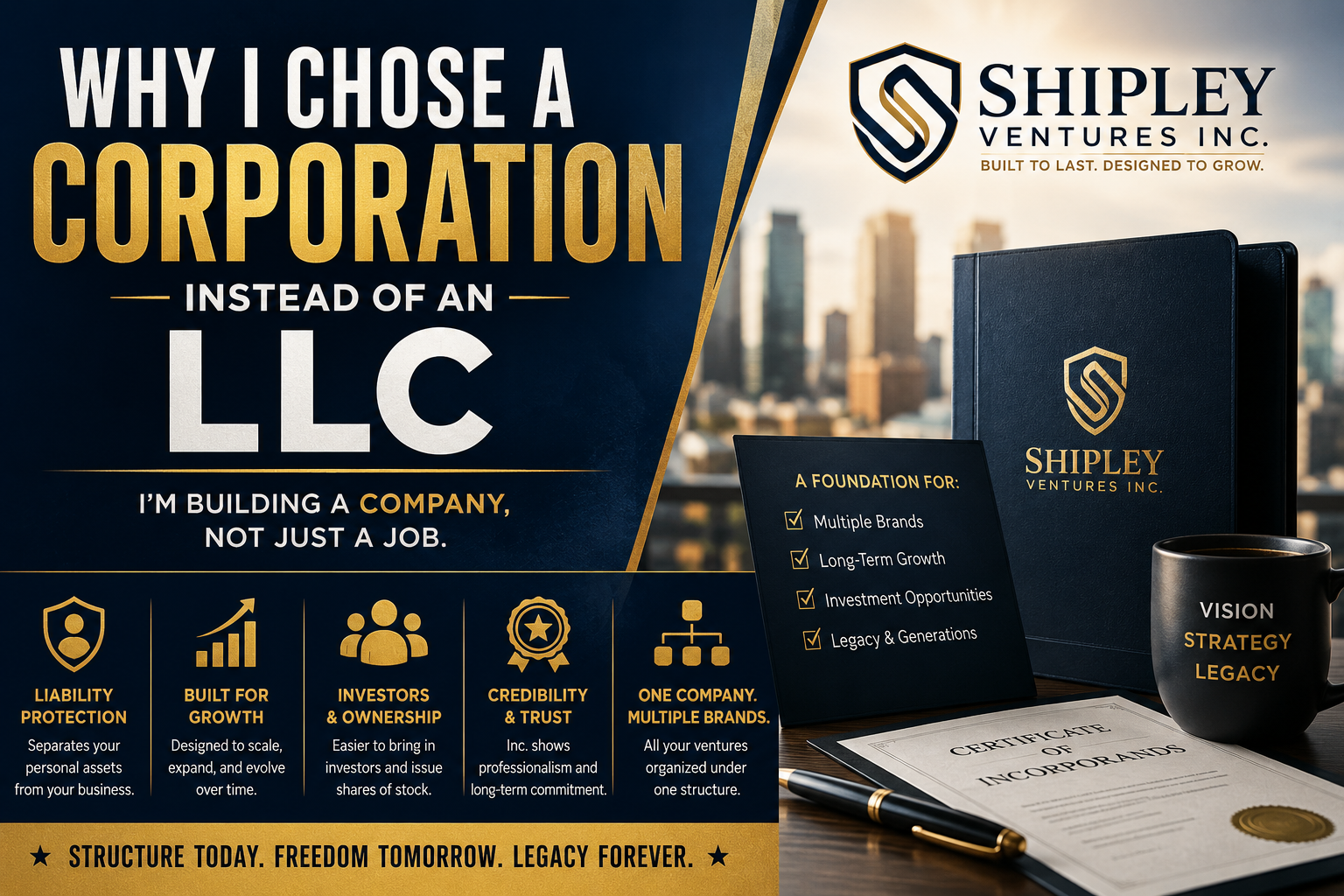
I'm Building a Company, Not Just a Job
I don't just want to create another way to make money.
I'm building something that can continue growing for years—something that can own brands, products, intellectual property, and future businesses.
A corporation is designed for that kind of growth.
Instead of thinking only about what my business looks like today, I'm building for what I want it to become ten years from now.
One Company. Multiple Brands.
My vision isn't centered around one product.
It's centered around one company that owns multiple ventures.
For example:
The R.I.S.E. Rebuild
Coming Into Truth
Digital products
Educational programs
Investments
Future business opportunities
Instead of creating a separate business every time I have a new idea, those brands can exist under one corporate umbrella.
That creates structure and keeps everything organized.
Credibility Matters
Whether we like it or not, people often view an incorporated business differently.
Seeing "Inc." after a company name can communicate permanence, professionalism, and long-term commitment.
That doesn't automatically make a business better—but first impressions matter.
Preparing for Future Growth
Corporations are also built to accommodate future expansion.
If I ever decide to bring on investors, issue stock, add owners, or even sell part of the business, a corporation already has the legal framework to support those possibilities.
I may never need those features—but I'd rather build a foundation that can grow with me than one I eventually outgrow.
It's About Thinking Bigger
This decision wasn't about taxes.
It wasn't about looking more important.
It was about building with intention.
I wanted a structure that reflected where I'm headed, not just where I am today.
Final Thoughts
Every entrepreneur's situation is different, and an LLC may absolutely be the right choice for many businesses.
The important thing isn't copying someone else's structure.
It's choosing the structure that aligns with your vision, your goals, and the future you're trying to build.
For me, that meant choosing a corporation—and building something designed to last.
Disclaimer: This article is for educational purposes only and reflects my reasoning for choosing a corporate structure. It is not legal or tax advice. Always consult a qualified attorney or tax professional before deciding which business structure is best for your situation.
Here are some of the biggest misconceptions of choosing a Corporation over an LLC:
“A C corporation is only for big businesses.” Not true. “C corporation” is primarily a federal tax classification for a corporation. A corporation can have one owner, little revenue, and no employees. You don't magically need a boardroom full of people to qualify. 😆
“You need multiple owners to have a corporation.” Nope. A corporation can generally have a single shareholder. That same person can also serve in multiple corporate officer/director roles, subject to the corporation's governing documents and state law.
“An LLC protects you, but a corporation doesn't.” Both structures can provide limited liability. And neither one creates an impenetrable force field around the owner. Personal guarantees, mixing personal and business finances, fraud, failure to respect the entity, and certain personal acts can still create personal liability.
“If you form a corporation, you're automatically paying more taxes.” Way too simplistic. A C corporation pays federal corporate income tax on its taxable profits. If after-tax profits are distributed to shareholders as dividends, those dividends can potentially be taxed again at the shareholder level—the famous “double taxation.” But that doesn't mean every dollar that enters a corporation gets taxed twice. Compensation, legitimate business expenses, retained earnings, distributions, and the owner's individual circumstances all matter.
“LLC means one tax system and C corporation means another.” This one trips people up constantly. An LLC is a state-law entity type, while federal tax treatment is a separate question. Depending on circumstances and elections, an LLC can be taxed as a disregarded entity, partnership, S corporation, or even C corporation. So “LLC vs. C corp” sometimes mixes two different concepts.
“A corporation means you can never touch the company's money.” You absolutely can receive money from your corporation—but there needs to be a legitimate reason and proper accounting for it. Salary, reimbursements, dividends/distributions, loans, etc. aren't interchangeable with “I need $200, so I'll just swipe the business card.” 😂 Separation and documentation matter.
“Putting ‘Inc.’ after your name automatically protects your personal assets.” Nope. The corporate structure helps create separation, but you have to operate it like a separate entity. Separate bank account, good records, corporate governance/formalities, appropriate contracts, and clean accounting are part of maintaining that separation.
“Corporations are better than LLCs.” This is probably the biggest misconception of all. Neither is universally “better.” An LLC may be simpler and more flexible for many owner-operated businesses. A corporation may make more sense when ownership through shares, outside investment, certain benefit/tax strategies, or a more formal governance structure fits the long-term plan.
This was a really good breakdown, Rodney. I especially appreciate you pointing out that neither structure is automatically “better.” I chose an LLC for my business, but I’m building multiple brands, products, and intellectual property under it too. This definitely gave me something to think about as I look at where I want the company to be 5–10 years from now. Thanks for sharing the reasoning behind your decision instead of just saying one structure is better than the other.
Thank you so much for sharing this information! 🙌🏽 Being completely new to the business world, I’m soaking up everything I can learn. Information like this is truly gold to me. I appreciate you helping those of us who are just getting started!






Comments
8 Jump to latestWhy I Chose a Corporation Instead of an LLC
When most people start a business, one of the first questions they ask is:
"Should I form an LLC or a Corporation?"
For many small businesses, an LLC is a great option. It's simple, flexible, and provides liability protection when operated correctly.
But after looking at my long-term vision, I decided to build my company as a Corporation.
Here's why.
I'm Building a Company, Not Just a Job
I don't just want to create another way to make money.
I'm building something that can continue growing for years—something that can own brands, products, intellectual property, and future businesses.
A corporation is designed for that kind of growth.
Instead of thinking only about what my business looks like today, I'm building for what I want it to become ten years from now.
One Company. Multiple Brands.
My vision isn't centered around one product.
It's centered around one company that owns multiple ventures.
For example:
The R.I.S.E. Rebuild
Coming Into Truth
Digital products
Educational programs
Investments
Future business opportunities
Instead of creating a separate business every time I have a new idea, those brands can exist under one corporate umbrella.
That creates structure and keeps everything organized.
Credibility Matters
Whether we like it or not, people often view an incorporated business differently.
Seeing "Inc." after a company name can communicate permanence, professionalism, and long-term commitment.
That doesn't automatically make a business better—but first impressions matter.
Preparing for Future Growth
Corporations are also built to accommodate future expansion.
If I ever decide to bring on investors, issue stock, add owners, or even sell part of the business, a corporation already has the legal framework to support those possibilities.
I may never need those features—but I'd rather build a foundation that can grow with me than one I eventually outgrow.
It's About Thinking Bigger
This decision wasn't about taxes.
It wasn't about looking more important.
It was about building with intention.
I wanted a structure that reflected where I'm headed, not just where I am today.
Final Thoughts
Every entrepreneur's situation is different, and an LLC may absolutely be the right choice for many businesses.
The important thing isn't copying someone else's structure.
It's choosing the structure that aligns with your vision, your goals, and the future you're trying to build.
For me, that meant choosing a corporation—and building something designed to last.
Disclaimer: This article is for educational purposes only and reflects my reasoning for choosing a corporate structure. It is not legal or tax advice. Always consult a qualified attorney or tax professional before deciding which business structure is best for your situation.
Here are some of the biggest misconceptions of choosing a Corporation over an LLC:
Not true. “C corporation” is primarily a federal tax classification for a corporation. A corporation can have one owner, little revenue, and no employees. You don't magically need a boardroom full of people to qualify. 😆
Nope. A corporation can generally have a single shareholder. That same person can also serve in multiple corporate officer/director roles, subject to the corporation's governing documents and state law.
Both structures can provide limited liability. And neither one creates an impenetrable force field around the owner. Personal guarantees, mixing personal and business finances, fraud, failure to respect the entity, and certain personal acts can still create personal liability.
Way too simplistic. A C corporation pays federal corporate income tax on its taxable profits. If after-tax profits are distributed to shareholders as dividends, those dividends can potentially be taxed again at the shareholder level—the famous “double taxation.” But that doesn't mean every dollar that enters a corporation gets taxed twice. Compensation, legitimate business expenses, retained earnings, distributions, and the owner's individual circumstances all matter.
This one trips people up constantly. An LLC is a state-law entity type, while federal tax treatment is a separate question. Depending on circumstances and elections, an LLC can be taxed as a disregarded entity, partnership, S corporation, or even C corporation. So “LLC vs. C corp” sometimes mixes two different concepts.
You absolutely can receive money from your corporation—but there needs to be a legitimate reason and proper accounting for it. Salary, reimbursements, dividends/distributions, loans, etc. aren't interchangeable with “I need $200, so I'll just swipe the business card.” 😂 Separation and documentation matter.
Nope. The corporate structure helps create separation, but you have to operate it like a separate entity. Separate bank account, good records, corporate governance/formalities, appropriate contracts, and clean accounting are part of maintaining that separation.
This is probably the biggest misconception of all. Neither is universally “better.” An LLC may be simpler and more flexible for many owner-operated businesses. A corporation may make more sense when ownership through shares, outside investment, certain benefit/tax strategies, or a more formal governance structure fits the long-term plan.
Awesome for you. Hope it all works out for you. I have an LLC for my business maybe I'll add this to it? Love the topic.
Great breakdown @RodneyInRebuild
This was a really good breakdown, Rodney. I especially appreciate you pointing out that neither structure is automatically “better.” I chose an LLC for my business, but I’m building multiple brands, products, and intellectual property under it too. This definitely gave me something to think about as I look at where I want the company to be 5–10 years from now. Thanks for sharing the reasoning behind your decision instead of just saying one structure is better than the other.
@RodneyInRebuild
Thank you so much for sharing this information! 🙌🏽 Being completely new to the business world, I’m soaking up everything I can learn. Information like this is truly gold to me. I appreciate you helping those of us who are just getting started!
Thanks Rodney, I ppreciate this